

Atlantic City: Transition and Loss

There is no way to remember my father apart from the story of Atlantic City, New Jersey—its heyday, decline, and troubled reinvention as a gambling destination. This is the story my father told me. Like the city itself, it is both real and confabulatory.
Eugene was born at Atlantic City Hospital on December 18, 1923. His mother, Rebecca, died during or shortly after childbirth. A year later, my grandfather, Alexander, falsified my father's birth certificate after marrying Cecelia, Rebecca's sister. Cecelia would later give birth to three daughters.
When the United States entered World War II in 1941, my father enlisted in the U.S. Army. Only then, when he was required to produce an accurate record of his birth, did he learn that the woman who had raised him was his aunt and that the three girls he knew as his sisters were also his first cousins.
The revelation destabilized his sense of self before he shipped off to the Philippines. He never spoke about what he felt when he learned the truth. Perhaps whatever happened inside him after that discovery remained inaccessible, even to himself. What emerged instead was bitterness. Until his death, he maintained that no one in the family wrote to him while he was overseas.
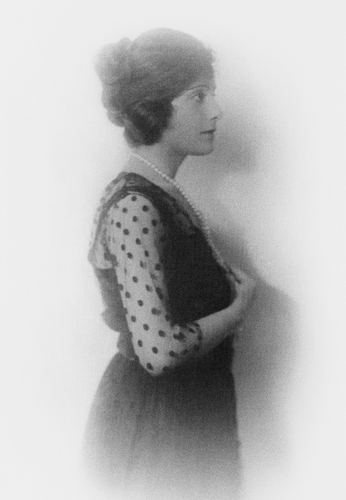
My brother and I did not learn our father's full history until the 1970s. Around that time, a large sepia-toned portrait appeared on our living room wall: a framed, full-length profile of a young woman. The family resemblance was unmistakable. Our paternal grandmother seemed a careworn shadow of the woman in the photograph.
"Your grandmother isn't my real mother, you know," my father would say, often apropos of nothing. He seemed unaware—or unconcerned—that he was repeating himself.
"We know, Dad."
Visitors were invariably led to the portrait.
"Have I shown you the photograph of my real mother?"
With rare exceptions, Atlantic City was the only destination beyond our home in Vineland, New Jersey, that my agoraphobic father was willing to drive to—and then only for the day. My grandparents lived in a tired apartment building on South State Avenue called Le Chateau. The hallways smelled of gefilte fish and brisket. A slow, clanking elevator with a rusting accordion gate was a ready-made playground.
I remember my paternal grandparents as loving and kind. My father, by contrast, was tense whenever we visited. Coiled. Upon arriving, he made a beeline for the mahogany liquor cabinet. He never asked permission. He poured himself brandy and drank, fortifying himself for the visit.
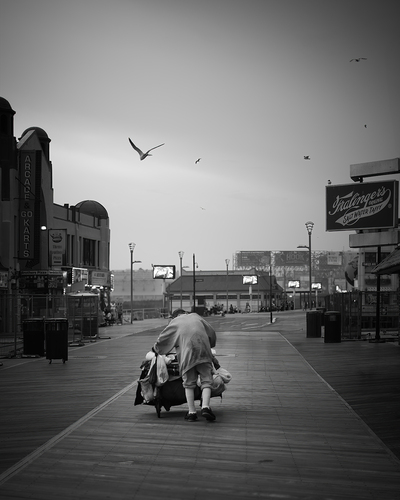
My younger brother and I, self-absorbed children inured to simmering family dysfunction, turned our attention to the fading grandeur of the Boardwalk a short walk away. The route took us past blocks of boarding houses and modest homes. Today, none remain. They have been replaced by casinos and the vacant lots of long-abandoned development projects. The predominantly Jewish neighborhood where my father grew up has disappeared.
Even as he dismissed the promises of casino gambling to revive Atlantic City, the city never loosened its hold on him. He remained nostalgic for the Atlantic City of the 1930s. As a high school teacher, he found the social changes of the 1960s unsettling. He felt alienated by his students' language, dress, and music, and took comfort instead in the big-band era. He loved Benny Goodman, the "King of Swing," and the vocalists Ella Fitzgerald, Sarah Vaughan, and Billie Holiday. He mourned the transformation of Atlantic City for the same reason he mourned the country itself: both had become places he no longer recognized.
My grandfather died of heart disease when I was thirteen. My grandmother—I never thought of her as my great-aunt—remained alone in the apartment. Inexplicably, Le Chateau was left standing even as every other building on her block was demolished. A heavy smoker, she was eventually crippled by emphysema. My father drove from Vineland to Atlantic City every weekend to visit his housebound stepmother until her death. I imagine they talked about the weather, or sat together in silence.
Three decades later, my father was living at the New Jersey Veterans Memorial Home in Vineland. He had dementia. Residents wore security anklets to prevent them from wandering, but one day his was inadvertently removed, and he walked off the grounds. Local police officers became concerned when they spotted an elderly man walking along the unpaved shoulder of Northwest Boulevard. They stopped and asked where he was going.
"I'm going to Atlantic City."

 Facebook
 Twitter
 LinkedIn
 Pinterest
 Tumblr
 StumbleUpon
 Reddit
 Email
Email Loading...